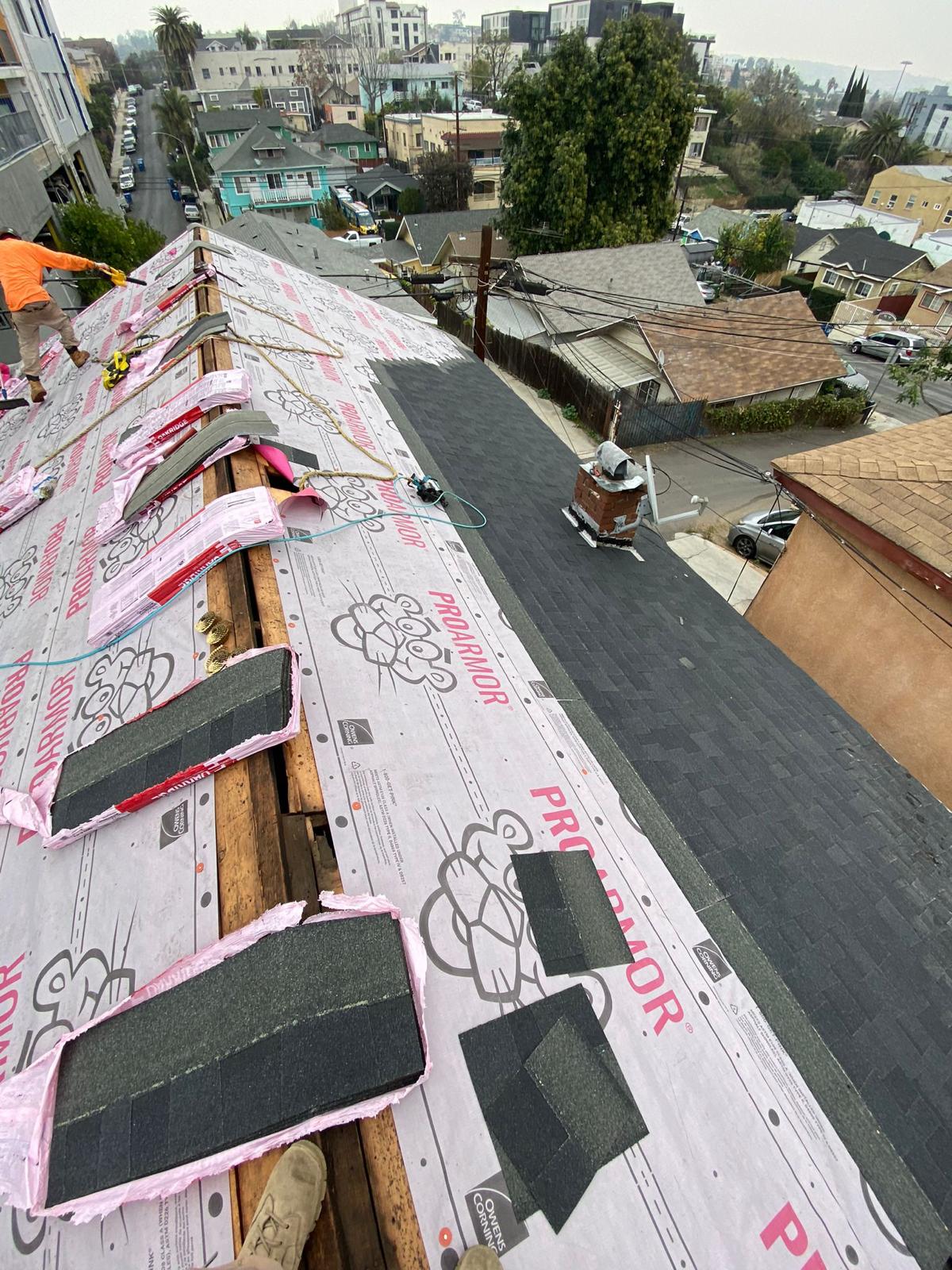
Key Takeaways: The biggest cost factors for an EPDM roof are the roof’s size and complexity, the membrane thickness you choose, and whether you’re doing a full tear-off or a recover. Labor and regional material costs are the other major variables. For a standard residential low-slope garage or addition in Los Angeles, you’re typically looking at a range.
So, you’re looking at an EPDM roof. Maybe an architect specified it, or you’ve heard it’s the go-to for flat and low-slope sections. The quote comes in, and your first thought is probably, “Wait, why does rubber cost that much?” We get it. Having installed acres of this stuff over the years, from small porch covers to massive commercial buildings, the price tag can be a surprise if you’re only thinking about the material roll itself.
The reality is, the membrane cost is just one piece. The final number is a puzzle built from your specific roof’s geometry, the condition of what’s underneath, and the quality of the installation system. Let’s break down what you’re actually paying for.
What is EPDM, Really?
EPDM (Ethylene Propylene Diene Monomer) is a synthetic rubber membrane, most often black or white, used primarily on low-slope roofs. It’s durable, flexible across a wide temperature range, and relatively simple to install compared to some other systems. Think of it as a giant, seamless rubber pond liner for your roof.
The Three Pillars of Your EPDM Quote
When we put together a proposal, three core elements drive 90% of the cost. Everything else is a variation on these themes.
- Substrate & Preparation: This is the make-or-break phase that homeowners rarely see. We can’t just roll rubber over old, wet, or uneven decking. Is the existing roof a full tear-off down to the plywood? Are we doing a “recover” over smooth, secure insulation? Is there rotten wood to replace? In older LA neighborhoods like Silver Lake or Hancock Park, where flat-roofed additions are common on classic homes, we almost always find surprises—water damage hidden under old tar, compromised decking. That repair work is labor-intensive and adds cost, but skipping it guarantees a short-lived roof.
- Membrane & System Choice: Not all EPDM is equal. The standard thicknesses are 45 mil and 60 mil (a mil is 1/1000th of an inch). 60-mil costs more but offers better puncture resistance and longevity—it’s what we typically recommend. Then, there’s the installation method. Will it be fully adhered (glued down across the entire surface), mechanically fastened (secured with plates and screws), or ballasted (held down with stone or pavers)? Each has different material and labor costs. Fully adhered is common here for its wind resistance and clean look, but it’s also the most labor-intensive.
- Labor & Complexity: This is where a simple 10’x10’ square becomes a different financial beast than an L-shaped roof with walls, pipes, skylights, and HVAC units. Every penetration (pipe, vent) requires careful flashing. Every wall needs a termination bar. Inside and outside corners need precise seams. More cuts, more seams, more detail work = more time. Labor isn’t just about speed; it’s about the skill to make those details watertight for decades.
The Hidden (and Not-So-Hidden) Line Items
Beyond the big three, these factors regularly adjust the final number:
- Access & Logistics: Is it a three-story building with no elevator? Do we need a giant crane to lift materials? Can we park a dumpster nearby, or do we need to shuttle debris by hand? A roof in a dense part of West LA with tight permits and parking is a different logistical puzzle than one in the Valley with a wide-open driveway.
- Warranty: A longer, stronger warranty (like a 20- or 30-year manufacturer’s warranty) often requires specific, certified installation methods and materials, which can add to the upfront cost. It’s an investment in long-term assurance.
- Local Code & Climate Adaptations: In Southern California, we’re increasingly thinking about solar readiness and reflectivity. A white EPDM membrane (which costs a bit more) reflects solar heat, reducing cooling costs. If you might add solar panels later, we need to plan the layout and reinforcement points during installation. It’s cheaper to do it right once.
When DIY Becomes a False Economy
We’ve been called to fix enough DIY and handyman EPDM jobs to know where it goes wrong. Seaming is a specialized skill—it’s not just tape; it requires clean substrate, primer, and seam tape applied with the right pressure and temperature. Improper flashing around penetrations is the #1 leak point we see. If your roof has any complexity beyond a simple, small square, the risk of a costly leak far outweighs the savings on labor. A professional install isn’t just about laying rubber; it’s about providing a system with a warranty and knowing how to handle the unexpected when we peel back the old roof.
A Realistic Cost Breakdown Table
Here’s a look at how the costs typically allocate for a mid-sized, straightforward residential job (like a garage or addition) with a full tear-off and a quality 60-mil fully adhered system. This is a generalized model; your project will differ.
| Cost Component | Approx. % of Total Cost | What It Encompasses |
|---|---|---|
| Labor & Installation | 40% – 50% | Tear-off/disposal, deck prep, membrane cutting/seaming, flashing details, clean-up. This is the value of skilled work. |
| Membrane & Core Materials | 25% – 35% | EPDM membrane rolls, seam tape, adhesives, primers, insulation, fasteners, flashing metals. |
| Substrate Repair & Prep | 15% – 25% | Replacing rotten plywood, leveling the deck, installing proper vapor barriers or insulation. The “unseen” critical work. |
| Overhead & Profit | 10% – 15% | Insurance, licensing, tools, vehicles, and business sustainability. A legitimate contractor needs this to be there for the warranty. |
Is EPDM Even the Right Choice?
EPDM is fantastic for its flexibility and proven track record. But it’s not the only player. For some projects, a TPO (thermoplastic) membrane might be comparable in cost and offer higher reflectivity. For a steeply sloped application, it’s the wrong choice entirely. Part of our job at California Green Roofing is to have that honest conversation upfront. We’ll tell you if EPDM is the best fit for your specific roof shape, use, and budget, or if another solution makes more sense for your Los Angeles home.
The bottom line is that an EPDM roof is a system, not just a product. The cost is in creating a seamless, watertight skin tailored to your building’s unique shape and challenges. It’s an investment in decades of protection, and like most investments, the quality of the execution determines the return. Get multiple quotes, but pay close attention to the details in the scope of work—that’s where you’ll see if they’re pricing a proper system or just the bare minimum.
Related Articles
People Also Ask
The 25% rule in roofing is a common insurance guideline used to determine coverage for roof replacement. It states that if a roof has sustained damage to 25% or more of its total surface area, many insurance policies will cover a full roof replacement rather than just spot repairs. This rule exists because repairing only a portion of an aged or extensively damaged roof is often not cost-effective or structurally sound; matching materials can be difficult, and the remaining sections are more likely to fail soon. It's crucial to have a professional inspection after a storm or event to document the extent of damage accurately, as insurance adjusters use this assessment to apply the rule. Homeowners should review their specific policy, as terms can vary.
The cost to install an EPDM (ethylene propylene diene terpolymer) roof typically ranges from $4.50 to $8.50 per square foot for a standard installation on a low-slope commercial or residential building. The final price depends on several factors. These include the roof's complexity, the thickness of the membrane (commonly 45 mil or 60 mil), the chosen installation method (fully adhered, mechanically fastened, or ballasted), and regional labor rates. Additional costs for insulation, removal of an old roof, or extensive deck repairs can increase the price. For an accurate estimate, it is essential to get a detailed assessment from a licensed roofing contractor who can evaluate the specific project conditions and provide a quote based on current material and labor costs in your area.
The cost for an asphalt shingle roof on a 500 sq ft house typically ranges from $2,500 to $5,500, with a national average around $3,500 to $4,000. This estimate includes materials, labor, and disposal of old roofing. The final price depends heavily on factors like the quality of shingles (3-tab vs. architectural), the complexity of the roof's pitch and design, your geographic location, and the cost to remove the existing roof. For such a small area, contractors may have a minimum project fee. Always obtain multiple detailed written estimates that specify the exact materials, warranty coverage, and scope of work to ensure a fair comparison and professional installation.
EPDM (ethylene propylene diene terpolymer) rubber roofing is a popular single-ply membrane, but it can experience several common problems. Improper installation is a primary issue, leading to seam failures, shrinkage, and punctures from foot traffic or debris. Over time, EPDM can become brittle from UV exposure if not properly protected with a coating. Ponding water due to inadequate slope can accelerate deterioration and cause leaks. Another frequent concern is membrane penetration from rooftop equipment installations or repairs. Regular professional inspections are crucial to identify and address these problems early, such as resealing seams, applying protective coatings, and ensuring proper drainage to maximize the roof's lifespan.
The cost of an EPDM roof installation in California is influenced by several key factors. The primary cost driver is the roof's square footage and complexity, with steep slopes or numerous penetrations increasing labor time. The thickness of the membrane (commonly 45, 60, or 90 mil) also affects material price. Labor rates, which vary significantly by region, are a major component. The chosen installation method—fully adhered, mechanically fastened, or ballasted—impacts both material and labor costs. Existing deck condition and necessary preparatory work, like removing old roofing or repairing the substrate, add to the project total. For a detailed analysis of value versus investment, we recommend our internal article EPDM Roofing In Los Angeles: A Cost-Effective Solution?.
EPDM roofing costs are influenced by several factors, making a precise calculator complex. A ballpark figure for material and professional installation typically ranges from $4.50 to $8.50 per square foot. Key variables include the roof's square footage, the thickness of the EPDM membrane (commonly 45 mil or 60 mil), and the complexity of the installation. Additional costs for insulation, edge metal, adhesives, and flashing must be factored in. Labor costs vary significantly by region and contractor. For an accurate estimate, it is best to consult with a certified roofing professional who can assess the specific project details, including deck condition and any necessary preparatory work, to provide a detailed quote.
The cost to replace a rubber (EPDM) roof typically ranges from $8 to $14 per square foot for a full replacement, including materials and professional installation. The final price depends heavily on factors like roof complexity, accessibility, the condition of the existing deck, and local labor rates. A simple, low-pitch roof on an easily accessible single-story building will be at the lower end, while multi-story buildings with complex penetrations or significant decking repairs will increase the cost. It is crucial to get a detailed, in-person inspection and written estimate from a licensed contractor, as proper installation is critical for the long-term performance and warranty of the roofing system.