Condo roofing // for HOAs
HOA Roofing Los Angeles:
a plan the board can pass
A Los Angeles HOA board answers for roofs its members rarely see up close. Our roofers walk every roof, photograph what they find and turn it into a single proposal for the board’s vote. After the vote, the crew moves through the community one building at a time, and residents can usually stay in their homes throughout.
Board-ready proposal, in writing
Written notice to each home
Licensed, CSLB #1100046
HOA roofing Los Angeles guide
Step one // the roof walk
An HOA roof assessment that starts on the roof
A board can only plan for roofs it can see. Many directors know their roofs from the ground, from the last leak report and from one line in the reserve study, and none of those shows what is happening at the valleys, flashings and drains. Our assessment puts each roof in front of the board as it really is, with a photo of every problem worth knowing about.
On each building one of our roofers logs the covering and its wear, then photographs each defect it finds. The board gets a page of its own for each building. Condo roofing decisions for a three-story block and the tile on the clubhouse are then made on their own terms, and any repair that should not wait is marked at the top.
Reserve study // Civil Code 5550
How often should an HOA inspect its roofs? In many associations, Civil Code section 5550 requires a visual inspection of the major components at least once every three years for the reserve study, and the board reviews that study every year. How much more often to look is the board’s call.
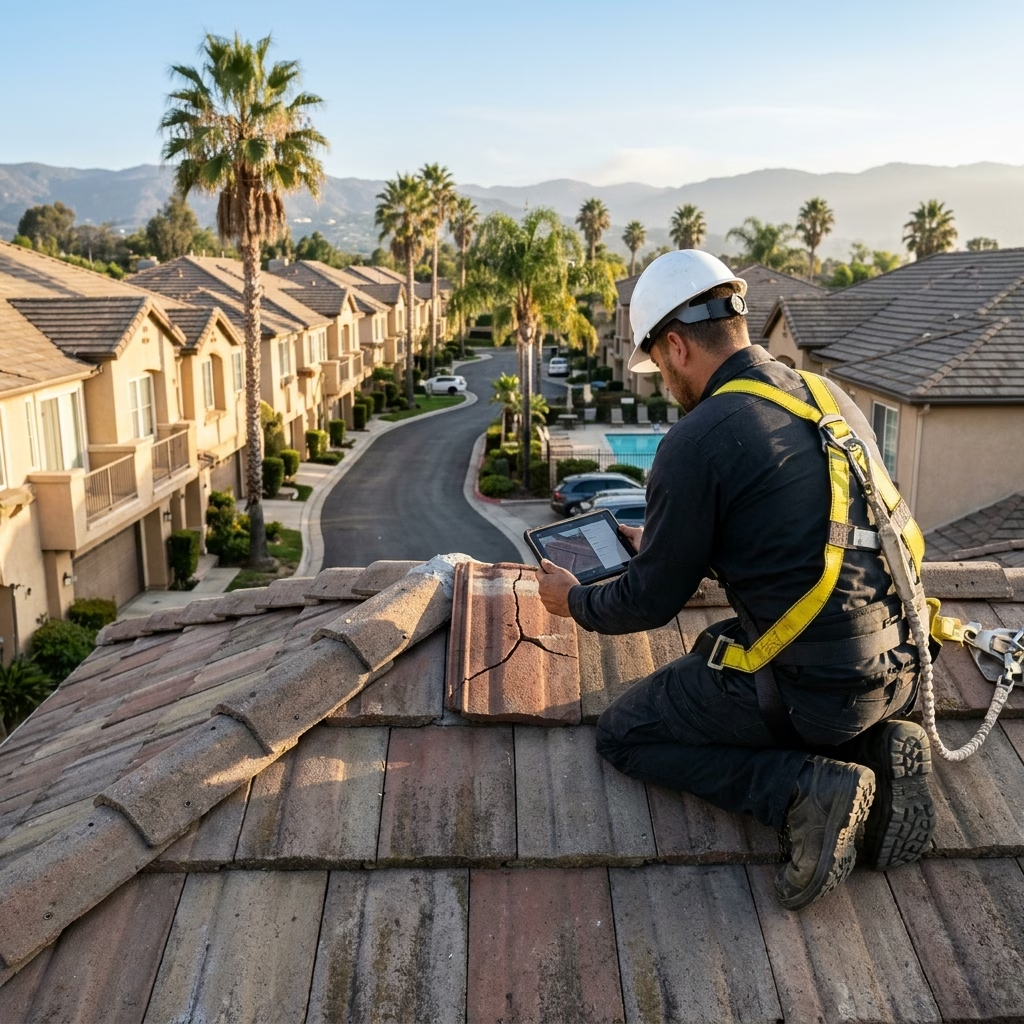
Roof walk // photo record
Five sheets // one vote
A board-ready proposal from your HOA roofing contractor
Civil Code section 4910 bars a board from acting on any item outside a board meeting, and owners may be watching when it acts. So our proposal is built to work on paper: five sheets a director can read once, question line by line and vote on with confidence.
Sheet 01
// Condition
The state of each roof
Roof type, condition and every defect we found, each with its photograph, set out building by building. Repairs that should not wait come first on the page, and the board can approve them before the larger plan is settled.
A photo for every defect
A page for each building
Written in plain English
Sheet 02
// Choices
Repair, coat or replace
In condo roofing, a tall block and a townhouse row rarely age at the same pace. The sheet says which buildings need an HOA roof replacement now, which need repairs or a coating, and which can wait for a later phase, with the reasoning beside each.
A verdict for each building
Why, in a sentence or two
What can wait, flagged
Sheet 03
// Scope
The work, item by item
Each layer is spelled out per building: tear-off, new underlayment and covering, flashing work, warranty terms and the city permit. An itemized scope lets the board see what each HOA roofing contractor actually includes and set our proposal beside any other it is reviewing.
Line items for each roof
City permit in the scope
Workmanship backed 20 years
Sheet 04
// Schedule
Buildings grouped in phases
The order follows the roofs, with the buildings that need work soonest in the first phase. Dates are agreed with your community manager, and each phase notes what changes for parking, walkways and the pool while the crew is on site. Every household also gets written notice before work reaches its building.
Order set by roof condition
Calendar set with your manager
Closures noted in advance
Sheet 05
// Handover
Records the board keeps
Closing an HOA roof replacement is partly a paperwork job. The association’s files receive one set: photos of each finished building, every city sign-off and the warranty papers, ready for the next reserve study update.
Closing photos, roof by roof
City sign-offs attached
Warranty papers in one set
HOA roofing contractor // Los Angeles
How to compare HOA roofing companies before the vote
Two proposals for the same community can describe two different jobs. Before the vote, run the proposal from each HOA roofing contractor through the same six checks and ask for anything missing in writing. A gap on paper tends to turn into a change order once the roofs are open.
Check 1
The license, looked up
Look up the license of any HOA roofing contractor with the Contractors State License Board and confirm that it is active and issued to the company named on the proposal. Ours is CSLB #1100046.
Check 2
A scope for every building
Each building in an HOA roof replacement should have its own scope: what comes off, what goes on, and which details such as flashings, vents and drains are replaced instead of reused.
Check 3
The permit, named in writing
The proposal should say who pulls the city building permit and who meets the inspector. On our projects the permit is ours to pull, for every re-roof, and the sign-off comes back to the board.
Check 4
Warranty terms you can read
Ask what the workmanship warranty covers and for how long, and get it on paper before the vote. Every new roof we install carries a 20-year workmanship warranty, written into the scope.
Check 5
What the proposal leaves out
Ask how the proposal handles damaged decking found after tear-off: who inspects it, who approves the repair and how the board hears about it before work goes on.
Check 6
Who is on the roof
Ask whether the crew on the roof works for the company named on the license or for a subcontractor, and get the answer written into the proposal.
Condo roofing // Los Angeles
Townhouse roofing, condo roofing and the common areas
Owners often ask who is responsible for roof repairs in a condo, and the answer starts in the CC&Rs. The Davis-Stirling Act puts the common area on the association unless the declaration assigns it elsewhere. The first task is knowing which roofs are common area and which belong to an owner, because in a townhouse community the owner often holds the roof over the unit, and one clause in the declaration can move a roof from the association to the owner.
01
Underlayment under townhouse tile
On a long townhouse row, leaks tend to start in the underlayment beneath tile that still looks sound. The usual fix lifts the tile, renews the underlayment and sets the same tile back, one row at a time.
02
Clubhouse and pool house tile
The clubhouse and pool house are usually common area, and clay tile is a frequent choice on them. Repairs and replacements follow the tile shape and color set in the guidelines and still match the homes around them.
03
Curled, worn shingle roofs
Curled tabs, granule loss and bare patches mark a shingle roof near the end of its life. Once the old layers are off down to the deck, new shingle goes on in the shade the association signed off on, one building after another.
04
Drains, seams and parapets
Condo roofing work on flat and low-slope roofs starts where water sits: around drains, at membrane joints and along the parapets. Whether the membrane gets a repair, a coating or a full condo roof replacement depends on how much life it still has.
05
Covered parking in the phases
Carport roofs are scheduled with the buildings they serve, and most residents keep cover for their cars while the crew works overhead.
See also
Apartment buildings
Rental buildings with a single owner follow a different decision path, with no board vote and no reserve study, which our page on Los Angeles apartment roofing explains.

Clubhouse // shared roof
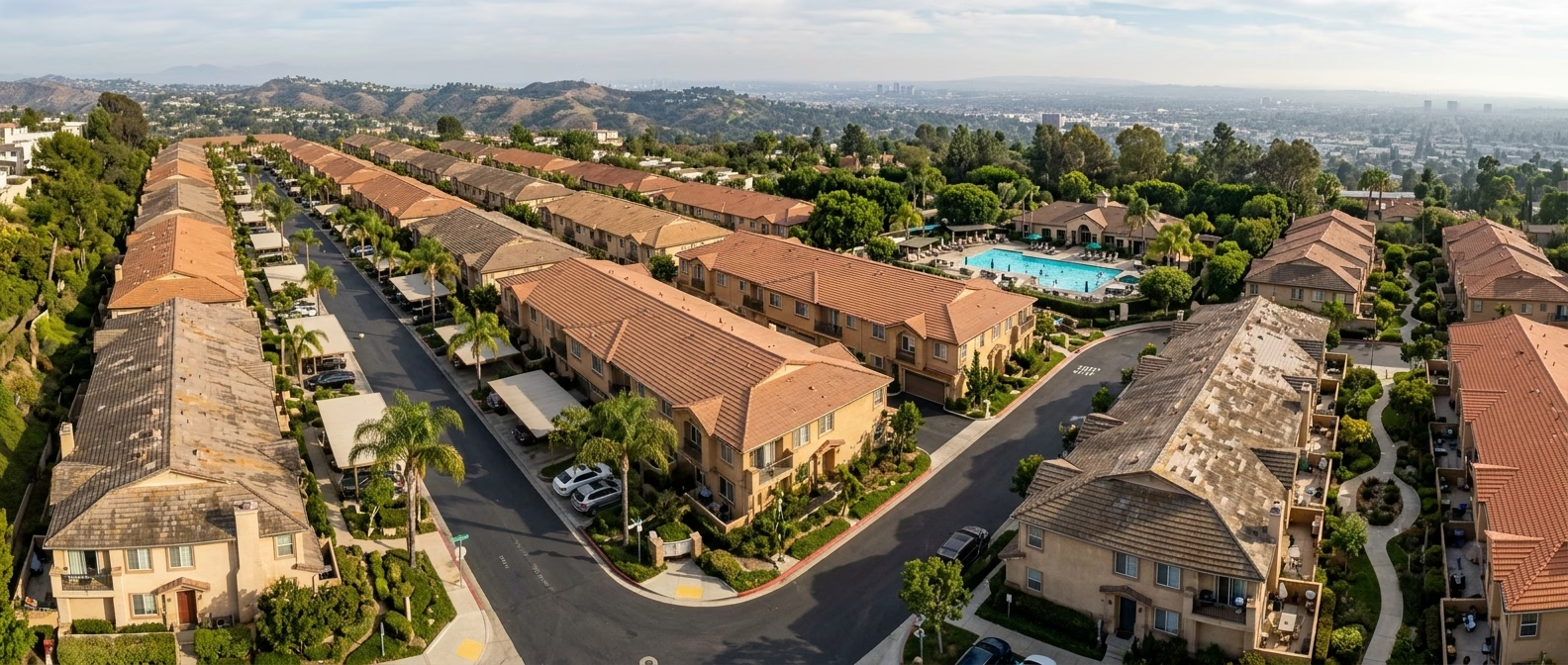
Aerial // townhouse roofing
HOA roof replacement // Los Angeles
HOA roofing guidelines, permits and fire ratings
In many communities the look of a roof is not up to the roofer: the architectural committee fixes the material, the tile or shingle profile and the color. Those rules only hold if each phase follows them. We write the approved product into the proposal, use it on every building and file it at closeout. A building that gets its HOA roof replacement years later can then match the first.
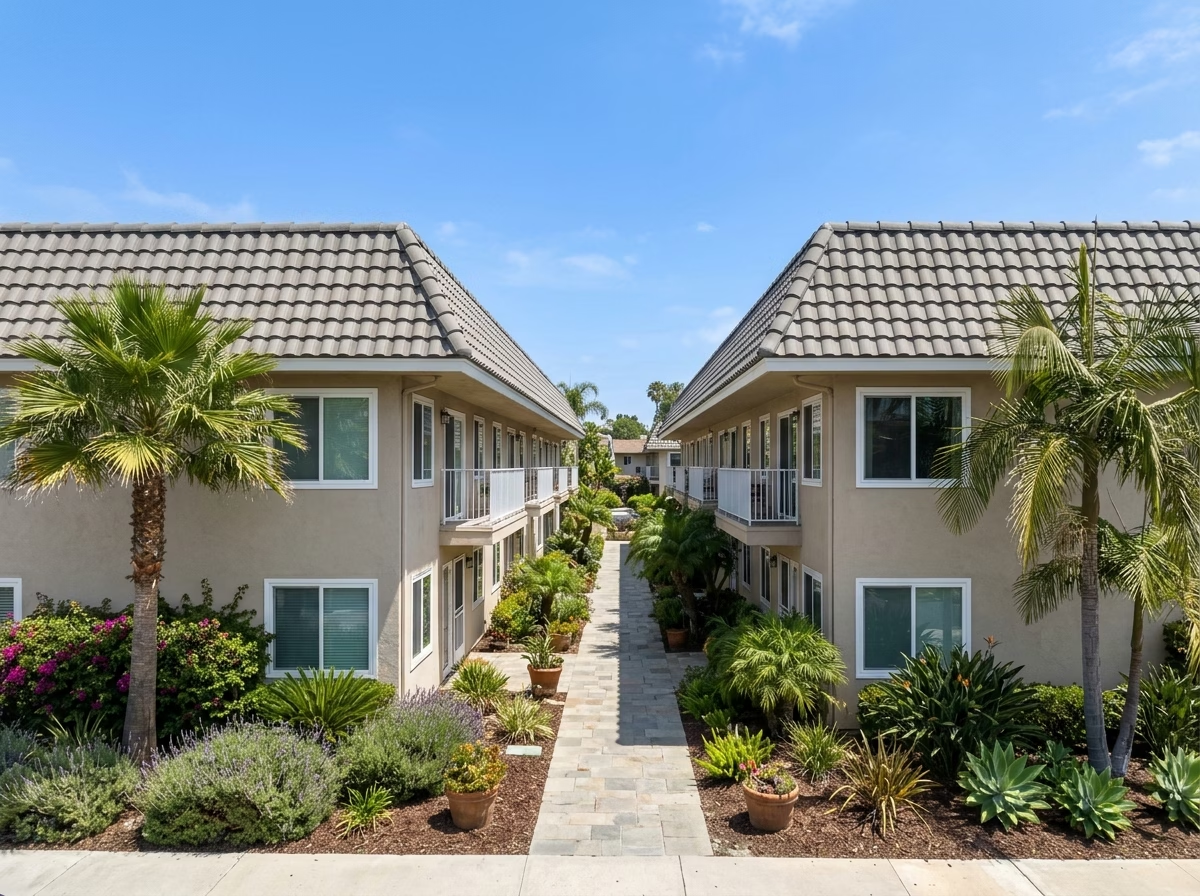
Same tile // a later phase
Rule 1
Committee approval comes first
Nothing goes on a roof until the committee has signed off on the material, profile and color, and that signed approval stays in the job file.
Rule 2
A permit for every re-roof
We pull the city building permit for every re-roof, and each building is inspected and signed off before the job closes.
Rule 3
Class A in fire hazard zones
In a Very High Fire Hazard Severity Zone the building code calls for a Class A roof covering, so a re-roof there needs a covering with that rating to pass inspection.
Rule 4
Cool-roof rules checked early
California’s Title 24 energy code can call for cool-roof products on a re-roof, depending on the slope and the climate zone, so we confirm what applies before the proposal is final.
Occupied buildings // phases
HOA roof replacement in phases the board approved
An HOA roof replacement happens over people’s heads, and the schedule deserves the same care as the materials. Residents get the dates in writing, a single building is opened at a time, and the crew leaves each one done and tidy before starting another. For what happens during the tear-off, see roof replacement in Los Angeles.
A
Notice delivered to every home
Before work starts, a letter goes to every unit in the building with the start date, the daily hours and what the crew will be doing.
B
A single roof open
Until one building is watertight again, the crew does not open the next one.
C
Entries and stairs reachable
Material staging is agreed with the manager in advance, so residents can still reach every door and stair.
D
Walkways cleared each day
Torn-off material is hauled out as the work goes, and the ground around the building is swept at the end of each working day.
E
Dates and calls in one place
Your manager deals with one project contact for dates, resident calls and the updates the board asks for.
F
Photos, sign-off, warranty
When a building is done we photograph it, the city signs off on the permit, and the 20-year workmanship warranty comes with the closeout papers.
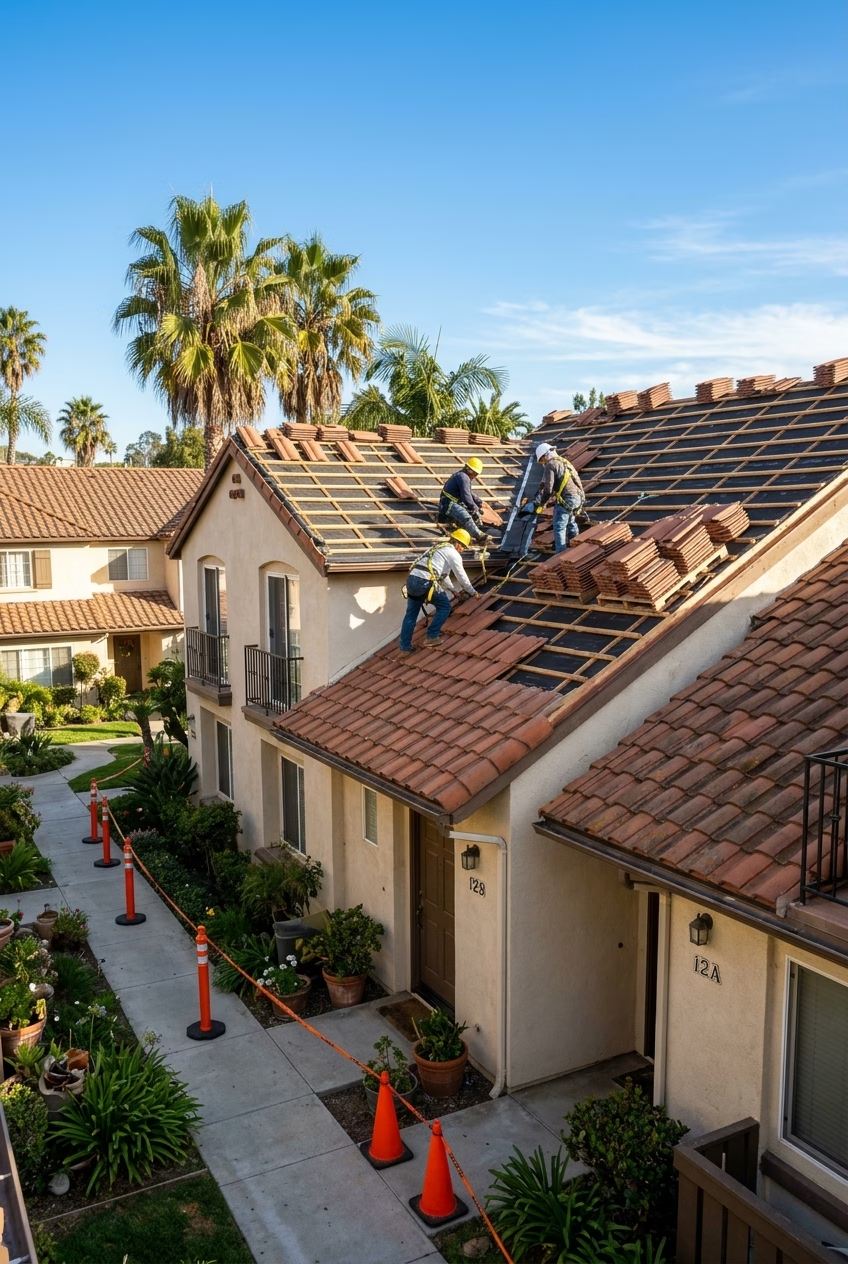
Work in progress // one roof
Between phases // care
HOA roof repair for roofs that can wait their turn
Many associations replace roofs over several years, which leaves the later buildings needing care in the meantime. HOA roof repair keeps those roofs watertight while they wait, and each service below is ours, done by California Green Roofing under one CSLB license.
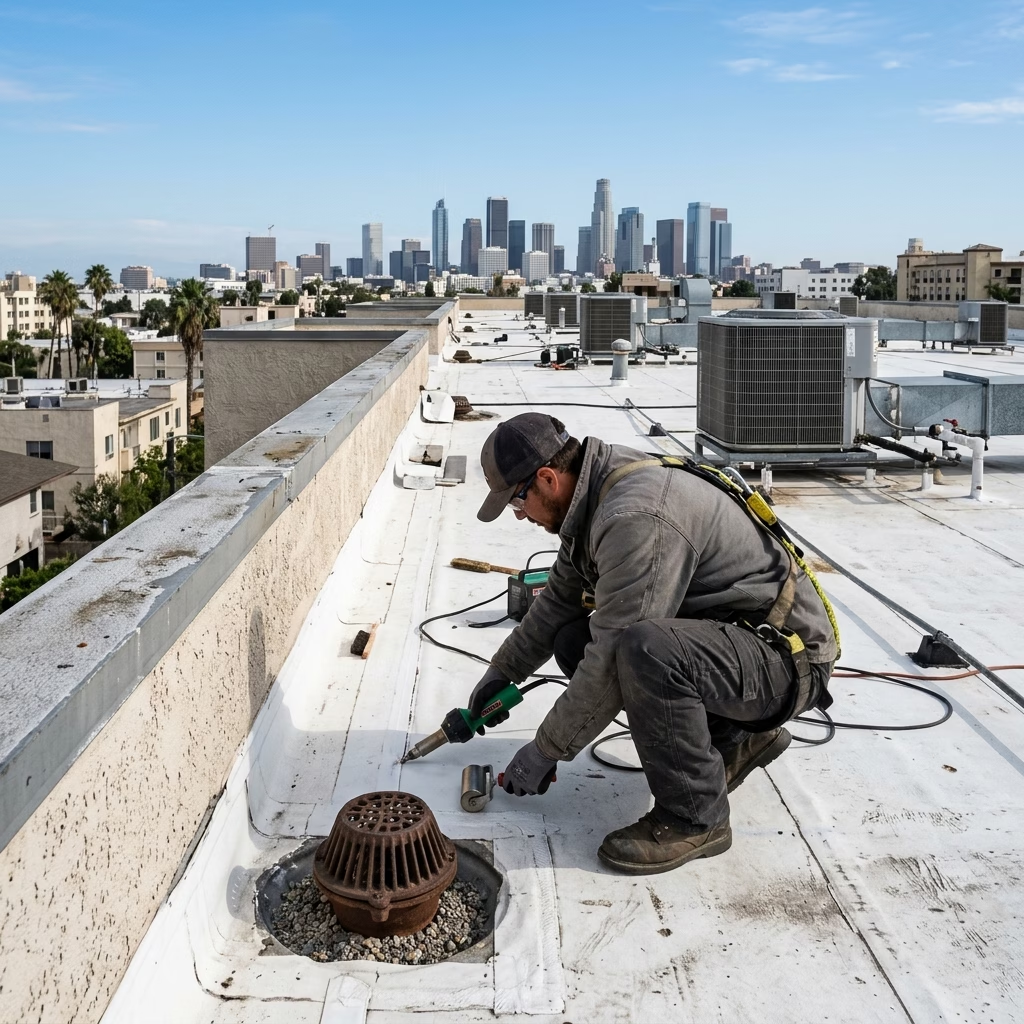
Condo roof repair // low slope
Scheduled roof maintenance
Routine visits on a set schedule check drains and flashings before the wet months.
Leak repair at the source
We follow the water back to its entry point, fix it there and send the manager photos.
Coatings for low-slope roofs
For condo roofing on a sound low-slope membrane, a coating can buy more years.
Storm and emergency repair
Wind and rain damage tarped and fixed, with calls answered every day.
Written roof inspections
Inspection findings put in writing, roof by roof, whenever the board needs a current picture.
Common questions // HOA
HOA roofing Los Angeles: questions boards and owners ask
Answers on who pays, how often to inspect and how reserves shape condo roofing plans, written by an HOA roofing contractor for community managers, directors and owners.
Does HOA pay for roof repairs?
Usually, when the roof is common area. Civil Code section 4775 makes the association responsible for repairing and replacing the common area unless the declaration says otherwise, and in many condo buildings the roof is common area. In a townhouse community the owner may own the roof instead, so check the declaration before anyone schedules work. If the documents are unclear, the attorney for the association is the right person to read them.
Who pays for a roof leak in a condo?
The roof and the damage under it can have different answers. The association usually handles a roof that is common area, while the inside of a unit may fall to the owner or to the association, depending on the governing documents and the cause. In condominium roofing work we record where the water entered, so the board and the owner can settle it on facts.
How often should HOA roofs be checked?
Once a year and after major storms is a sound routine. The legal minimum is wider apart: in many associations the reserve study inspection under Civil Code section 5550 comes every three years. A yearly HOA roof assessment catches small faults between those studies. Keep the photos from each walk, because a trend over several years tells the board more than any single visit.
What if reserves cannot cover a roof?
Phase the work. An HOA roof replacement does not have to happen in one year: the buildings with the worst roofs go first, and repairs hold the others until the reserves can carry them. If a special assessment cannot be avoided, Civil Code section 5605 limits how large it can be without a member vote, and section 5610 lets the board go past that limit in the emergencies it defines.
Can our reserve study use your report?
Usually. The written assessment lists each roof by building, with its type, condition and photographs, which is the kind of record a reserve study preparer works from. The board can share it with the preparer, who decides how to use it, and we can walk the roofs again when the study is next updated. Photos taken the same way each time make one study easy to compare with the next.
Do you work with the board or manager?
Both. As your HOA roofing contractor we work day to day with the community manager on access, dates and resident questions, while proposals, scope changes and closeout records go to the board. One project contact keeps both sides informed from the first walk to the last sign-off.
Will new roofs match our guidelines?
Yes. Our proposal spells out the approved tile or shingle and its color building by building. It helps to have the architectural committee review that list before the board votes, so the vote covers a roof the committee has already accepted. Recording the product at closeout is the step that lets HOA roofing guidelines hold for buildings re-roofed years from now.
Can residents stay home during work?
Yes. Condo roofing is planned around people at home: the board and each household get written notice, the schedule shows when the pool or a parking row is affected, and entries and walkways stay usable. Expect noise during working hours, and plan for some cars to move while the crew works above a carport.
Why not keep patching the old roof?
Patching makes sense while the underlayment and roof covering are sound. When leaks start showing up in different units after each repair, every patch buys less time and draws down the reserves for little lasting gain. Our assessment shows which roofs are worth repairing and which are due for an HOA roof replacement, building by building.
Should we compare HOA roofing companies?
Yes, and on equal terms. The governing documents or a board policy may say how many proposals to collect, and where they are silent the number is up to the board. Ask each HOA roofing contractor to write its proposal for the same buildings and the same scope, then run every proposal through the six checks on this page.
HOA roofing // Los Angeles
Book the walk that starts the plan
Tell us how many buildings the community has and what the board has to decide. Call 747-298-6407 any day between 7 AM and 10 PM, or use the form, and we will arrange a roof walk with your manager. After the walk you receive the written assessment, then a proposal shaped for a board vote, with each building and phase on its own line.
Request // HOA roof walk
Service area
Los Angeles and surrounding areas
Call
Hours
7 AM to 10 PM, all week
License
CSLB #1100046, bonded
For the board // HOA