Roof repair and new roofs
Roofing Orange, CA
Historic Tile to Flat Roofs
From clay tile on 1920s bungalows to the flat roofs of the city’s 1960s Eichler homes, roofing Orange takes more than one kind of skill. We repair leaks, reset tile and replace worn roofs, and no work goes ahead until you have the photos and a written plan.
Leaks traced from the attic
Historic tile reset by hand
Photos of every hidden layer
Orange roofs, section by section
Housing eras
Roofing Orange Homes, From Bungalows to Tract Houses
The city’s median home was built in 1972, yet its historic district reaches back to the 1880s and its eastern hills meet open wildland. Roofing Orange homes starts with reading each roof by its era and its setting, whether you live under it, rent it out or manage it professionally.
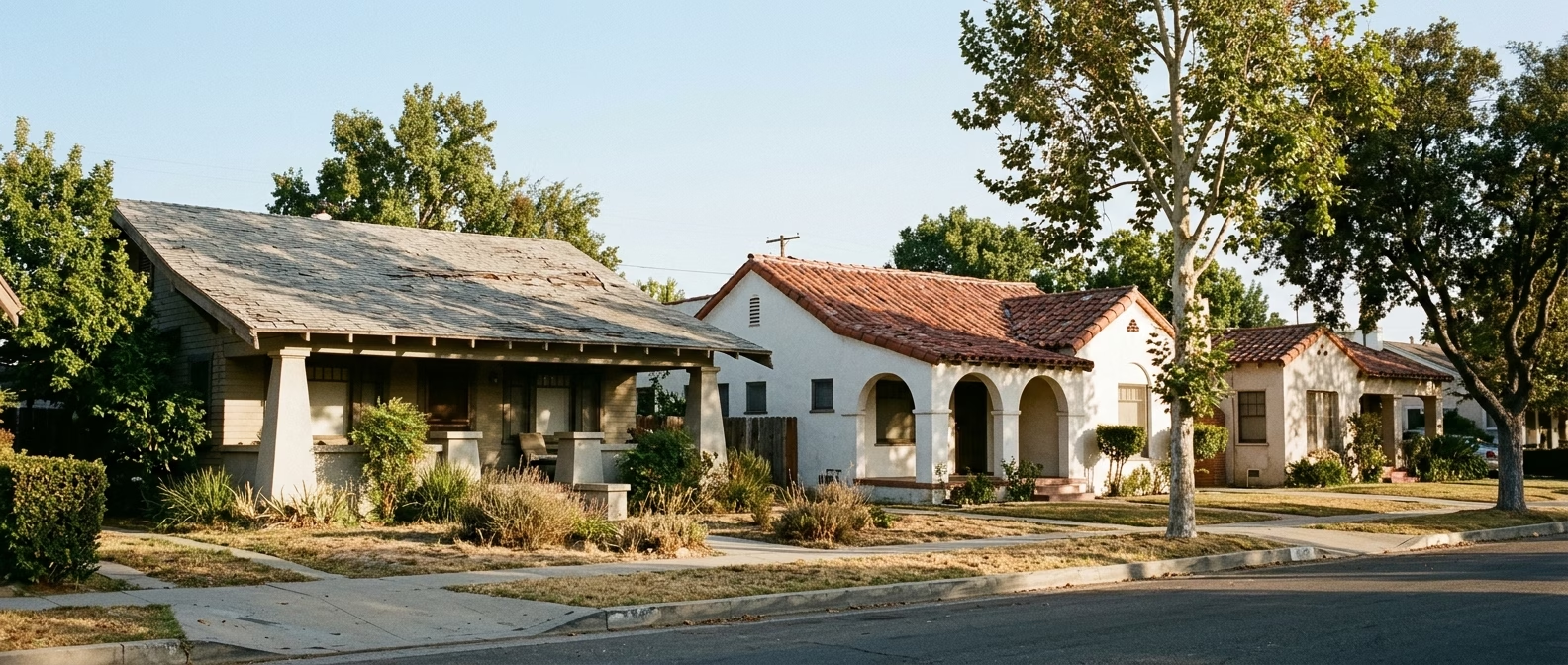
Around 1886
Victorian
Steep gables, turrets and porch roofs mean many seams to keep tight. Roof repair in Orange on these houses is often flashing work at chimneys, dormers and turret bases, where water finds a way in long before the covering itself gives out.
Around 1909
Craftsman
Low gables, deep eaves and exposed rafter tails. Those rafter tails sit outside the roof line, so a leak at the edge rots wood the street can see. When roofing Orange homes of that era, we check the eaves and fascia on every visit, not only the field of the roof.
Around 1910
Bungalow
Mostly a single story under a low gable or hip roof. Easy to walk and quick to repair, which is exactly why some get patched for years after the layer underneath has quit. We say plainly when a patch has stopped being the answer.
Around 1913
Spanish Colonial
Clay tile on low slopes, often with flat sections behind parapets that drain through openings in the wall. On a clay tile roof like this the flat sections and their drains often leak first, so we check them before touching a single tile.
1960 to 1963
Eichler
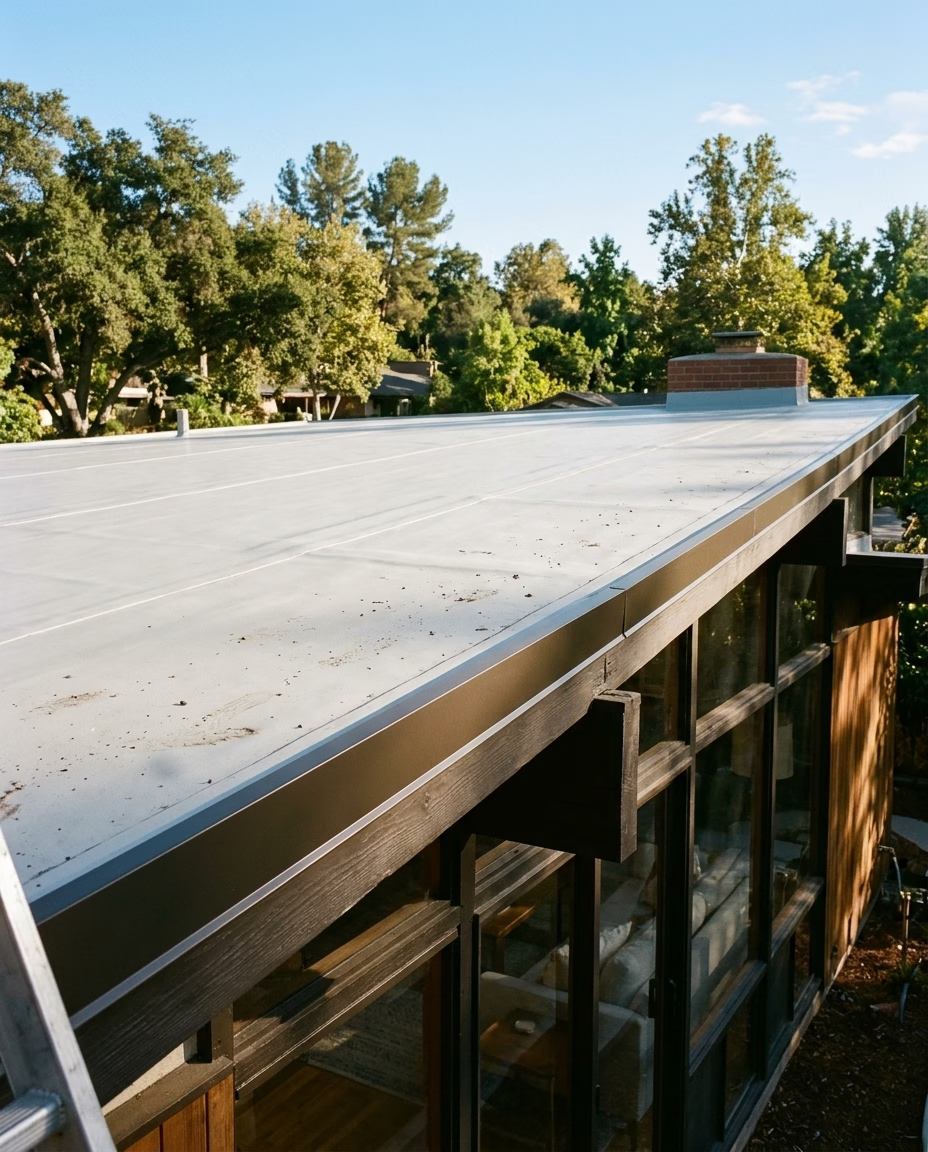
Three tracts of post-and-beam homes with flat and low-slope roofs, now local historic districts. Water moves slowly on roofs this flat, so standing water, worn membranes and tired edge flashing are the usual problems, along with keeping the slim roof edge intact.
1972 median
Tract homes
Simple gables under shingle or concrete tile, built around the city’s 1972 median year. A shingle roof laid then has long since been replaced, so for roofing Orange tract homes the question is usually whether the current roof is worth one more repair or ready for a new one.
Repairs
Roof Repair in Orange: Leaks, Tile and Flashing
Most leaks show up between November and April, when the city gets most of its roughly 14 inches of rain a year. Roof repair in Orange is easiest to schedule in the dry months, before the first storm finds the weak spots, and most of it falls into the four kinds below.
Leaks
Where the water starts
The first job on any leak is finding where the water gets in, not where it shows. We go into the attic and onto the roof in the same visit, photograph the path between them and mark the opening before anything comes off. Skipping the attic is how a roofing contractor in Orange ends up replacing the wrong part of a roof. That two-sided trace is the core of roof leak repair in Orange.
Tile
Tile that cracks or slides
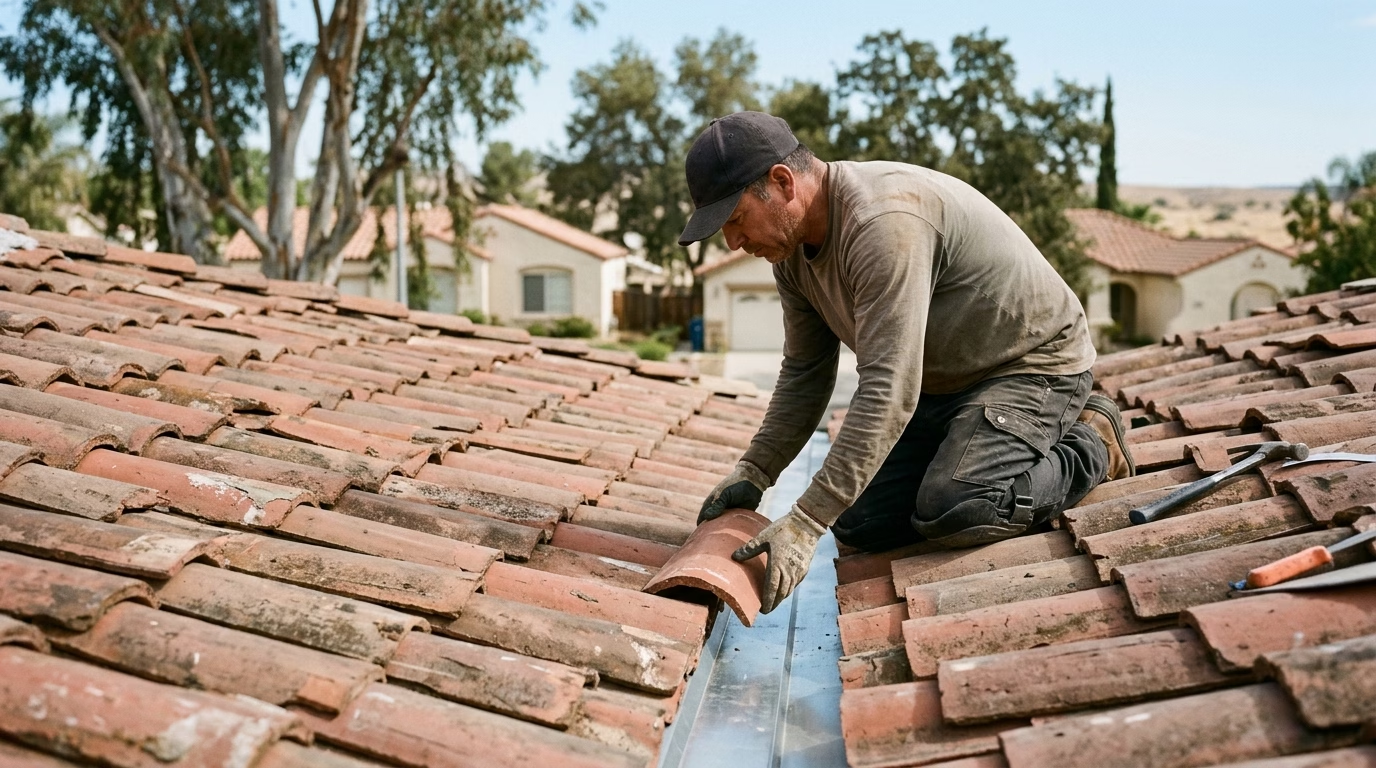
A cracked tile lets water reach the layer below, and a slipped one opens a gap the next storm will find. We lift the course above, reset or replace the tile, check the underlayment beneath and lay the course back so the pattern reads unbroken from the street. Tile lifted in a windstorm gets the same care.
Flashing
Flashing where slopes meet
Much roof repair in Orange happens where a roof changes direction: at the joints between slopes, along walls, around chimneys and at vents. Metal there works loose and sealant dries out in the summer heat. We replace tired flashing with new metal set to the roof, rather than adding another layer of sealant over the old.
Timing
Why a slow leak matters
Owners tend to ask one thing first: how serious is a roof leak that only drips in a hard rain? Less dramatic than it looks and more damaging than it seems: one drip can soak insulation, stain drywall and soften the deck within a single rain season. Roofers in Orange will each have a theory about where the water gets in, so ask to see the trace behind it. Roof leak repair from start to finish has its own page.
Replacement
Roof Replacement in Orange Once Repairs Run Out
A roof gets repaired or replaced on the strength of two things: the deck and the layer under the covering. When a roof repair in Orange keeps failing, the leaks move around or the deck is soft in more than one place, patching only buys a season. Roof replacement in Orange then means a full tear-off, and every step below is set out in writing before the work is scheduled.
01
Every old layer off
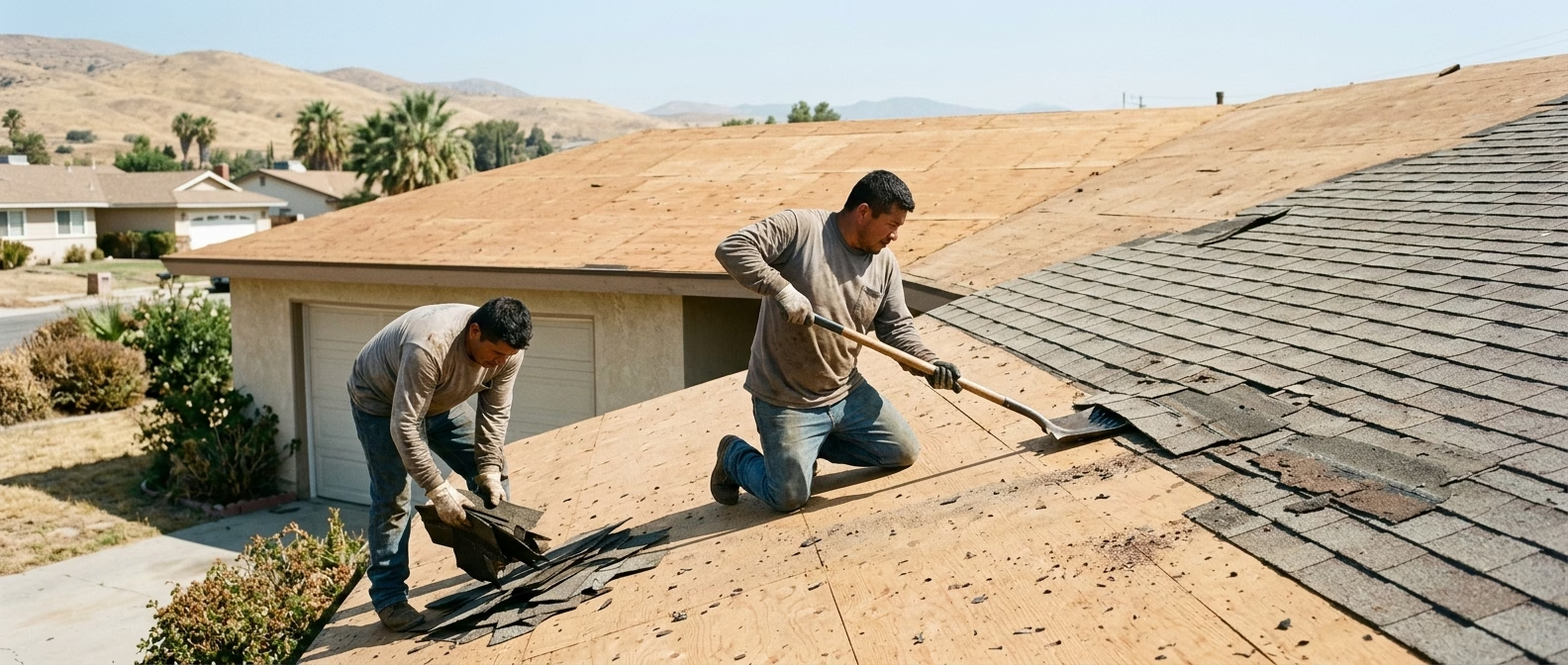
What is included in roof replacement starts here: every layer of old covering and underlayment comes off, so the deck can be seen whole. Nothing new goes over an old layer, and the stripped deck is photographed before work moves on. For the whole sequence, see how a full roof replacement runs.
02
Sheathing repair
Soft or delaminated sheathing is cut out and replaced with new panels of the same thickness, and the fasteners are checked across the rest. Expect a roofing contractor in Orange to list deck repair in the plan, since a soft deck under a new roof is how a new roof starts to sag.
03
Roof underlayment
The roof underlayment is the layer that keeps water out. Tile and shingle shed most of it, but whatever gets past them runs on this sheet. New underlayment goes on in full, lapped and fastened to the maker’s instructions, with extra layers along the low lines where runoff gathers.
04
Flashing and edges
New drip edge and new wall, chimney and pipe flashing are part of the job, not extras. Old flashing reused under a new covering is a common reason a fresh roof leaks in its first winter, so before you sign, ask the roofing contractor in Orange you choose whether the plan includes new metal.
05
Vents and fire ratings
Attic vents are checked, sized and replaced. On homes in the eastern hills, where dry offshore winds carry embers, we can fit ember-resistant vents and a Class A rated covering, chosen with you before anything is ordered.
06
Covering and cool roof
The new covering follows its maker’s installation rules to the letter. A cool roof is worth discussing on most re-roofs: California’s energy code sets cool roof values when more than half a roof is replaced in many of its climate zones, and we check the rule for your address before ordering. Ask for a plan to see it all for your roof.
Historic tile
Tile Roof Repair in Orange, Matched to Historic Homes
The city’s historic district has been on the National Register since 1997, and projects there go through the city’s design review. A repair that reads as new from the street is the wrong repair, even when it stops the leak completely.
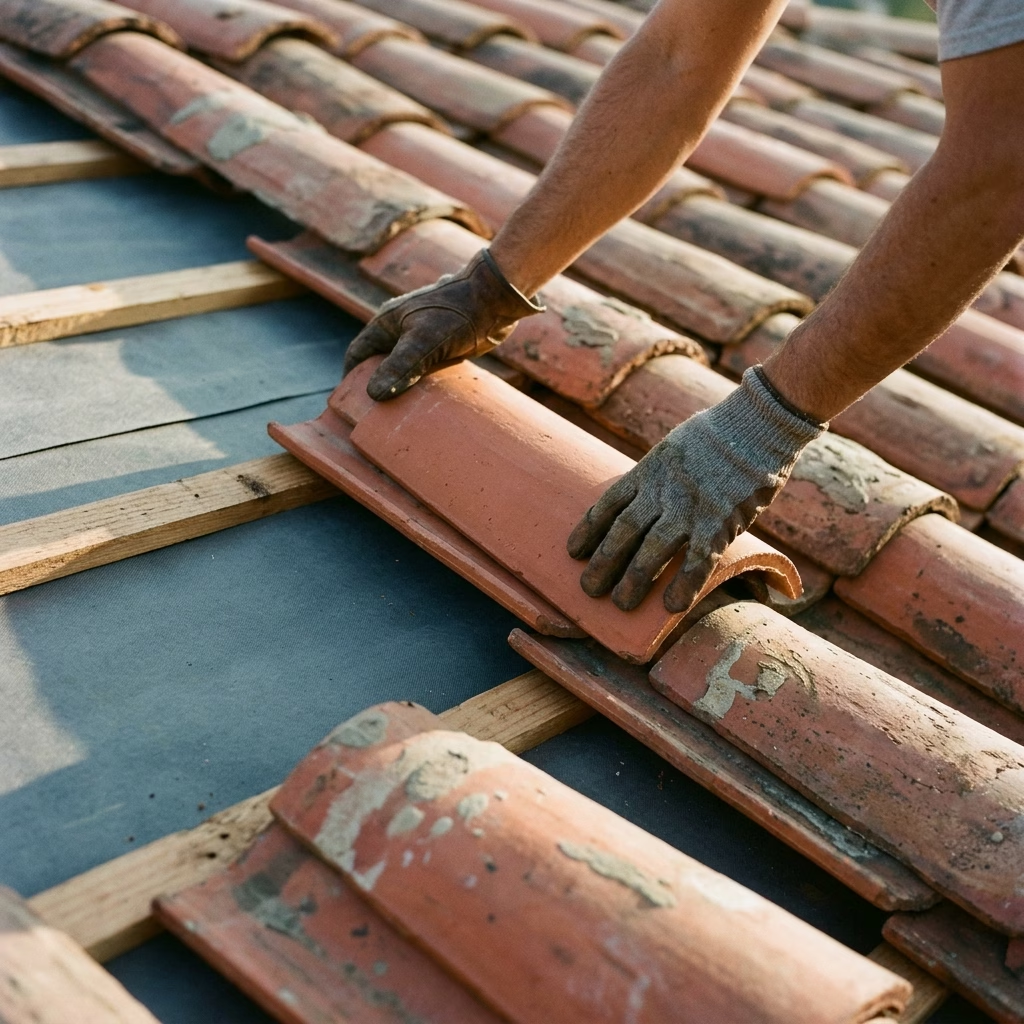
Tile roof repair in Orange starts with saving what is already up there. Clay tile from the bungalow and Spanish Colonial years was made in shapes and colors that new stock does not always match, so we lift sound tile by hand, stack it by course and set it back in the same pattern. Where pieces are broken, we match profile, color and weathering from salvaged or new tile and place any newer pieces where they show least.
Before anyone pulls up a single piece, owners in the district often ask: how long does a tile roof last? The answer comes in two parts. The clay can outlast the people who laid it. What wears out is the underlayment beneath, which on an older home may be decades past its useful life. That is why a repair here often ends with the original tile set back over a new layer, laid in full, with the tile returned to its battens in the same courses, rather than with a new roof.
On homes in the district we also leave eaves, rafter tails and fascia as they were built, and repair old wood rather than replace it where it is sound. We photograph the roof before and after, so you have a clear record of what changed. Ask each roofing contractor in Orange you are comparing how they match tile. The answer tells you most of what you need to know.
When roofing Orange homes in the historic district, allow for one more step: design review comes before exterior work starts, and a written plan with photos of the existing roof makes that step simpler.
Mid-century
Eichler Homes and Flat Roof Repair in Orange
The city’s three Eichler tracts, built from 1960 to 1963, became local historic districts with their own design standards in 2018. Their roofs are nearly flat, so flat roof repair in Orange starts with where water sits after rain, then with which of four systems the roof carries. Our roofing services in Orange start by naming that system.
Built-up
Layers of felt and hot asphalt under gravel, the system many homes of that era were built with. It holds up while the gravel stays in place and fails slowly at the edges and drains. Blisters and splits can be repaired in kind, but wet layers underneath mean stripping it down to the deck.
Modified bitumen
Rolled sheets of rubberized asphalt, laid in overlapping courses with sealed laps. It is a common replacement for a tired gravel roof because its seams are strong and its repairs simple. The laps at the roof edge and around skylights, where the sheets meet metal, get the closest look in our flat roofing work.
TPO
A white single-ply membrane with seams welded by heat rather than taped. It reflects summer sun, which keeps the rooms under a flat roof cooler, and white membranes like it are a common way to meet cool roof values on a low-slope roof. Every curb, vent and drain is then flashed to match.
Foam
Sprayed foam under a protective coating. It insulates as it seals and can slope water toward the drains, but it thickens the edge, which matters where the thin roof line is the point. Plan that edge with your roofing contractor in Orange first. Book a roof walk if water stands two days after rain.
Process
What You Get From a Roofing Contractor in Orange
A roof is the one part of the house most owners never see up close, so roofing Orange homes well means showing the work, not describing it. Before hiring a roofing company in Orange, ask for these six things. They are how we run every job as a roofer, from one slipped tile to a complete roof replacement.
Visit
A roof walk with photos
The visit covers the whole roof and the attic below it where there is access, and every finding is photographed, good and bad. What do roof inspectors look for? Soft or stained decking, cracked or slipped tile, lifted shingles, loose flashing, blocked drains and wet insulation. A full roof inspection follows the same list.
Plan
A written plan
You get the findings, the photos and the scope in writing: repair or replace, the materials, the steps and what happens if more damage turns up once the old roof is open. A roofing contractor in Orange who will not put that on paper is asking you to guess.
Schedule
Work timed to the weather
Roofing Orange through the winter means working between storms. Tear-offs are planned for dry stretches, and an open roof is covered before any forecast rain. From November to April that can mean a short wait for the right window, which beats a deck left open under a storm.
Protect
Gardens and tenants protected
Plantings are covered, walls and windows shielded and walkways kept clear of debris. Almost six in ten homes here are lived in by their owners, which leaves plenty of rentals, so residential roofing in Orange means planning around tenants too and keeping owners and property managers posted on each day’s work.
Clean up
Cleanup every day
Nails, scraps and old material are picked up as the work goes, and the yard and driveway are swept for nails before we leave. Gutters are cleared of anything the work put there, and the site is left the way you would want to find it.
Report
A photo report at the end
When the work is done you get photos of the finished roof and of the parts that end up hidden: the deck, the underlayment and the flashing. Those photos are a record you can hand to the next buyer, an inspector or the next roofing contractor in Orange who climbs up.
ZIP codes
Which Roofs Sit in Each Orange, CA ZIP Code
Roofing in Orange, CA covers five residential ZIP codes, from the historic center to the edge of the eastern hills. Two of them also take in homes outside the city, so their rows describe only the Orange part. Each row is a general starting point, never a verdict on your roof’s condition.
ZIP code
Area
Exposure
Typical work
ZIP code
92865
Area
North side
Exposure
Full sun, winter rain
Typical work
Shingle re-roofs, leak repairs
ZIP code
92866
Area
Central
Exposure
Summer heat, winter rain
Typical work
Tile resets, new underlayment
ZIP code
92867
Area
Northeast, city part
Exposure
Long dry summers
Typical work
Full replacement, deck work
ZIP code
92868
Area
West side
Exposure
Hot afternoons, winter storms
Typical work
Leak tracing, flashing repairs
ZIP code
92869
Area
East side, city part
Exposure
Dry offshore winds
Typical work
Re-roofs, vents, edge flashing
FAQ
Roofing Orange Questions From Owners and Landlords
Short, plain answers about roofing Orange homes, for owners, landlords and property managers weighing a repair, a new roof or the timing of either.
Roof repair in Orange or a new roof?
Choose a repair for a single leak, one cracked patch or a tired strip of flashing, provided the deck and underlayment underneath are sound. A new roof makes sense when problems turn up all over: several leaks, a spongy deck, brittle or curling covering. Ask to see the photos behind the recommendation before you decide either way.
How serious is a roof leak in Orange?
Serious enough to act on the same night, though rarely an emergency. Put a bucket under it, clear the furniture away, photograph the stain and where it sits, then book a roof repair in Orange before the next storm. Those photos help trace the opening faster.
How long is roof replacement in Orange?
Most single-story homes take days, not weeks. Heavy tile, soft decking found under the old roof and wet weather each stretch it. Expect the length in writing before work starts, along with how an open roof will be covered if rain is forecast.
Is winter too late for a new roof here?
Not if the work is planned around the storms. A roofing contractor in Orange can split a tear-off into sections that are closed up the same day, so the house is never left open overnight. Booking the roof walk in fall still gives you the widest choice of dates.
What do roof inspectors look for?
The condition of the deck, the covering, the flashing and the drainage. A good report shows each problem in a photo, says where it sits and what it needs, and separates urgent items from ones that can wait a season. Ask the roofing contractor in Orange you hire for that kind of report.
Do Eichler flat roofs need special care?
Yes. They are nearly flat with thin edges, so drainage and edge flashing matter more than on a sloped roof. Good repairs match the existing system and keep the slim roof line that defines these mid-century homes.
Why replace underlayment under tile?
Because new underlayment stops the leaks without changing the look. The work runs one section at a time: the old layer is stripped, the battens are checked or replaced, the new layer goes down and the original tile goes back on top.
Is a cool roof worth it in Orange?
Usually, yes. August is the warmest month here, and a light, reflective covering keeps the attic and the rooms below it cooler through the heat. Light tile, coated shingle and white membranes all come in cool versions, and state rules may call for one on a large re-roof anyway.
Roof survey
Talk to a Roofer in Orange About Your Roof
Send the form or call, and tell a roofer in Orange what the roof is doing: a stain, a slipped tile, water standing on a flat roof or a roof that is simply old. Whether it needs a quick roof repair in Orange or a full re-roof, California Green Roofing sets a time for the roof walk and puts the findings, photos and options in writing.
How to reach us
Roof survey // Orange